
Now that it looks like there might actually be some light at the end of this tunnel we have been crawling through for the past few months (and I don’t mean winter!), I find myself contemplating the many positive shifts that have come about from having what the Americans call their “civil liberties” restricted.
A common remark these days seems to be how being forced to slow down reminded us of what we really value and revived our appreciation for the little things in life. Many folk also seemed to get in touch with their “inner creative” during this time, finding new ways to pass the time productively. YouTube has probably never seen so much traffic as people researched everything from how to brew their own beer or make sourdough bread to yoga classes and growing vegetables!
My husband Robert has taken to woodwork and is making the most beautiful cutting boards using combinations of rare and unusual woods. Jennifer dreamed up a new writing and language coaching model and started a blog providing free academic writing advice to students. While in the process of developing a new app, Talana IS making dog biscuits and chutney! Such new inventiveness could be a saving grace for people who tragically now find themselves unemployed.
In the nursery, I have always told people who say they are keen on going into the plant business to grow something nobody else is growing or to offer some kind of unique garden-related service. A stroll around the stalls at our local Boeremark shows what fabulously different ideas people are able to come up with to make a living or simply keep busy.
How has your life improved over the long days since March, and how do you see yourself changing things in the future?
IN THE GARDEN
I suppose the description “Best time of year in the garden” would have to be reserved for the wonderful month of September but there really is something special about the sense of anticipation in August. I have just had a walk through the garden and although things still look quite bare and wintry, the sprouting leaves and buds here and there hold the promise of great things to come.
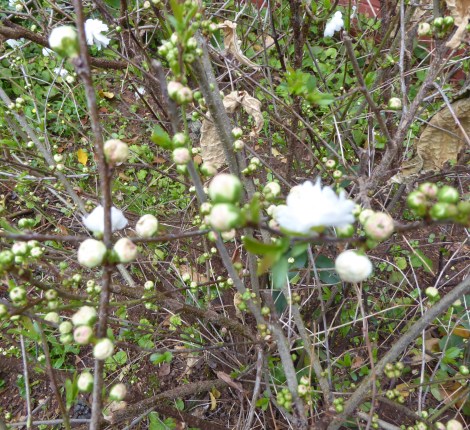
Prunus glandulosa coming into bud
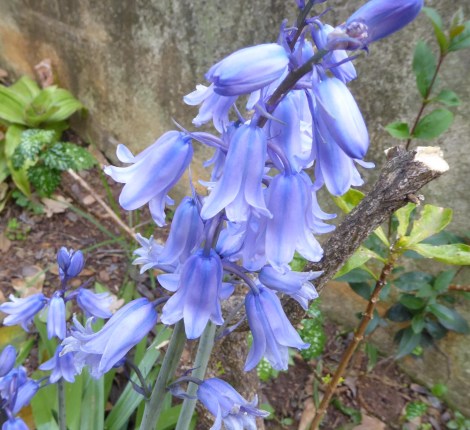
Bluebells

Abutilon pink lipstick
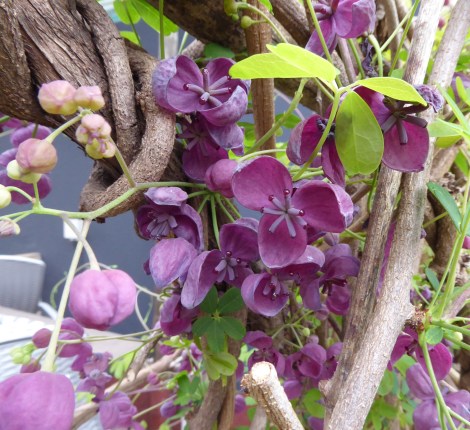
Akebia quintata
IN THE NURSERY
We are pleasantly surprised at how well our nursery plants coped with the exceptional winter cold this year. There seems to be a reluctance to sprout, however, and plants are still reasonably small for this time of the year. Hopefully things will change in the next week or two as temperatures start to rise.
Click here to view all the plants featured in this newsletter.
· Indigenous plants
Bulbinella nutans is a rare clump forming deciduous bog perennial with narrow fleshy leaves and dense racemes of yellow flowers in winter to spring which the bees love. Indigenous to the Western Cape, it grows to a height of about one metre and likes semi shade. This is the tall yellow plant we see en masse in all those photographs of the Namaqualand flowers. Who would have thought that I would one day have some for sale in the nursery!
For colour in the garden throughout the season, consider Hibiscus pendunculatus. This dainty upright evergreen shrub grows about one metre high and has large solitary pink flowers from spring to autumn. Plant in sun to semi-shade.
The large leathery deep green leaves of Rumohra adiantiformus are a familiar sight in florist bouquets due to their longevity. This rhizomatous creeping indigenous fern is widespread in South Africa and a lovely filler for deeply shaded and moist areas in the garden. It grows about 75cm high.
Our wild flax, Linum africanum, is found from the Western Cape up to Port Elizabeth. This compact perennial with upright stems and small leaves has lovely yellow flowers in summer. Evergreen and hardy, it can take sun to semi -hade and wants dry sandy soil. It grows so well in my garden.
· Exotic plants
The hyacinth orchid, Bletilla striata, is a clump forming deciduous terrestrial orchid with sprays of lilac-pink flowers in spring. Ours are just starting to push out their first buds. This is hardy plant that wants semi-shade and to be kept dry in winter. Divide in early spring.
The flowering quince - much loved by older generations - is an absolute joy when the blooms burst forth on its bare branches in late winter. We have the white Chaenomoeles x superba alba in stock. This tough floriferous deciduous shrub is very hardy and grows about one metre high. Bees love it and the fruit makes a delicious jelly. Plant in a sunny spot.
The red-eyed bright green flowers of Euphorbia Tiny Tim bring something special to the springtime garden. This is a compact rounded evergreen perennial with red-backed dark green leaves. A Mediterranean hybrid, it can take sun or semi-shade, but wants dry sandy soil. Attracts butterflies.
Heliotropium arborescens is a lovely well-shaped perennial with rough oval dark green leaves and vanilla scented purple-mauve flowers from summer to autumn. Evergreen and hardy, it grows about 70cm high and likes part shade. Good for attracting birds and butterflies to the garden. They need to be pruned back now!
SNIPPETS
Bill Liltved, co-author of The Cape Orchids published in 2012 to excellent reviews, is making standard edition copies available at the reduced price of R1,500 per set of two volumes. He will also accept any reasonable offer for the three remaining partially leather-bound collectors’ editions (including the prized first edition). He can be contacted on 082 3347526 or 021 7891069.
I am thrilled to see that Checkers has started up the “Little Garden” promotion again, as last time this got quite a few non-gardeners interested in plants and how they grow. Fortunately, they have decided to do it in spring this TIME; the annual autumn seedlings did not last long. I wish them every success!
In light of the runaround the weather is giving us, we have decided to move our Spring Open Weekend to 12 and 13 September. We will however also be open on Sunday 6 September for anyone who was counting on that weekend.
Happy gardening!
Leoné
082 482 0257